What Is a Managed AI Provider? (We Just Named the Category)

Founder, The Fort AI Agency
What Is a Managed AI Provider? (We Just Named the Category)
There is a new discipline showing up next to your IT stack. We are naming it.
Managed AI Provider. MAP for short.
You will not find it in a Gartner report yet. That is the point. Categories do not get named by analysts -- they get named by the operators who do the work first and write the definition down.
Here is the definition: a Managed AI Provider runs your AI infrastructure the way an MSP runs your IT infrastructure. Different stack. Different failure modes. Different contracts. Different team.
If you have an MSP today, keep them. Networks, uptime, patching, helpdesk, security -- that work did not stop mattering. Most businesses would not survive a week without their MSP. AI is a separate layer, and it needs its own provider.
Why a Separate Provider?
The honest answer: because AI fails for completely different reasons than your network does.
A network outage is usually a hardware fault, a misconfiguration, or a compromised endpoint. The MSP playbook is well-understood -- monitoring, redundancy, runbooks, ticketing.
An AI failure is usually a hallucinated answer, a leaked piece of customer data, a model update that breaks an integration overnight, or a vendor changing pricing structure with thirty days' notice. Different stack. Different runbook. Different team.
Most companies are not going to hire ML engineers, fine-tune models, write retrieval pipelines, negotiate BAAs with Anthropic and OpenAI, monitor token costs, A/B test prompts, and rebuild the whole thing every time a frontier model drops.
So somebody else has to. That somebody is a MAP.
What a Managed AI Provider Actually Does
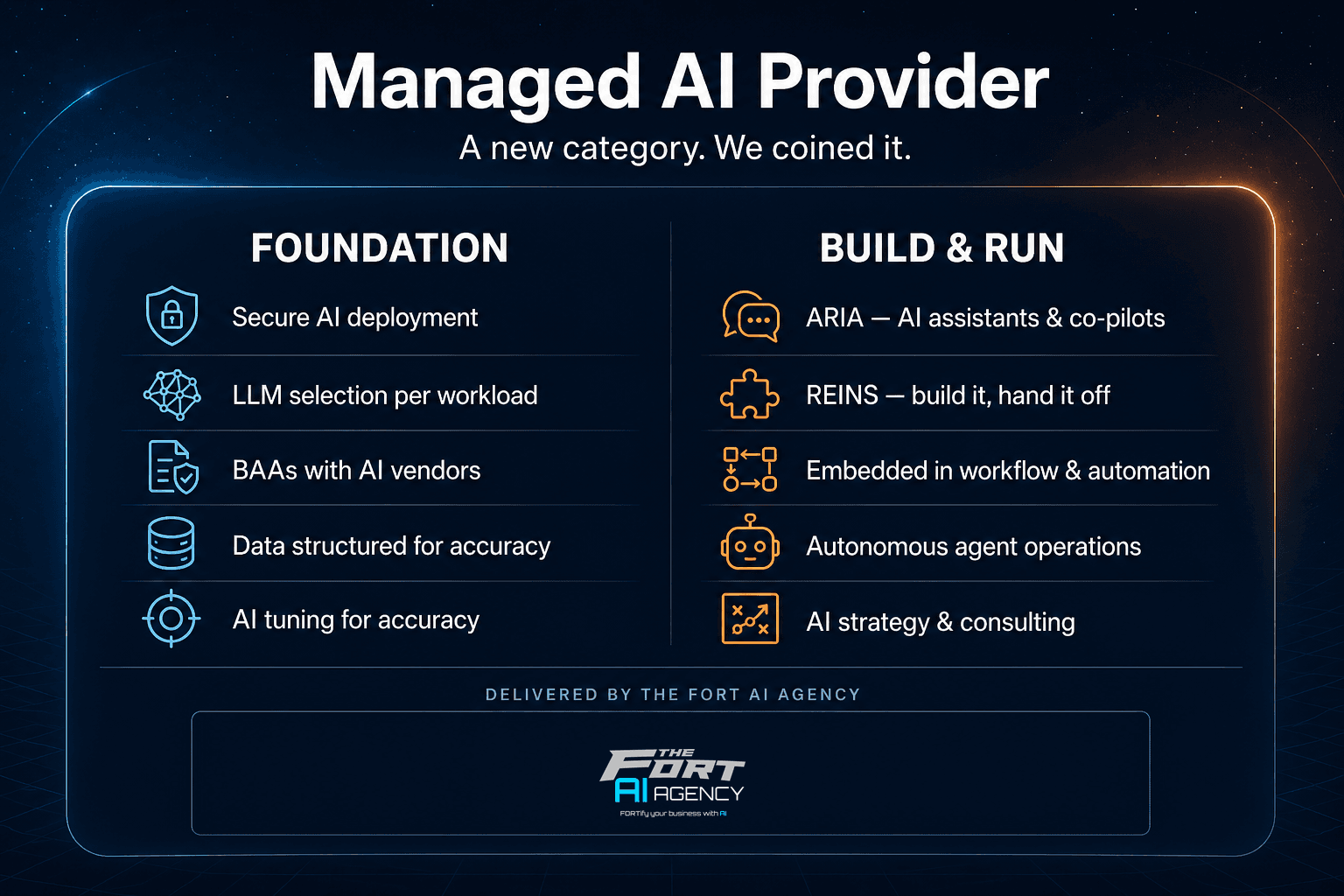
We split the work into two layers: Foundation (the architectural decisions that have to be right before any AI ships) and Build & Run (the systems that get built and the operations that keep them running).
Foundation
- Secure AI deployment. AI gets deployed inside your infrastructure, not in a vendor's tenant where you cannot audit it. This is the question most "AI strategy" decks skip, and it is the only question that matters once you handle real data.
- LLM selection per workload. Claude, GPT, Gemini, open-weights. Picked on real tradeoffs -- latency, cost, accuracy, compliance -- not brand loyalty. There is no "best" model. There is the right model for the workload.
- BAAs with AI vendors. If you handle PHI, financial records, or anything privileged, you do not get to use vanilla ChatGPT. You need real contracts. We get them in place before a single token of your data moves.
- Data structured for accuracy. AI does not fail because the model is bad. It fails because nobody structured the data for an LLM to actually use. That is the unsexy 70% of the work and it is what separates a demo from production.
- AI tuning for accuracy. Prompts, retrieval, evals. Tuning until the answers are something you would put in front of a customer.
Build & Run
- ARIA -- AI assistants and co-pilots. Purpose-built per role, per workflow, per dataset. Generic chat does not move the needle. The assistant for your accountant is not the same assistant for your service tech.
- REINS -- we build it, your team takes the REINS. Ready Engineered Intelligence, Now Self-sustaining. We do not lock you into a forever retainer. We build the system, hand it over, and your team operates it.
- Embedded in workflow and automation. AI inside the systems your team already uses, not another tab they have to remember to open.
- Autonomous agent operations. AI that runs the work, not just answers questions about it. This is what we run for ourselves and for our customers right now. It is the part of the job that feels closest to the future.
- AI strategy and consulting. The upstream "how do we even use this" conversation. Cheaper than building the wrong thing twice.
What a MAP Is Not
A MAP is not an AI product. It is not a single tool you bolt onto your business. It is the operations function that makes AI usable inside a real company.
A MAP is also not an MSP-with-AI-bolted-on. The disciplines look adjacent from the outside, but the day-to-day work is fundamentally different. The skill set is different. The vendors are different. The failure modes are different. Trying to cover both inside one team is how you get bad AI delivered by tired people.
Where We Sit
The Fort AI Agency is headquartered in Fort Wayne, Indiana, and we work with businesses across the Midwest and beyond. We are the team on the ground delivering the MAP work -- the architecture conversations, the integrations, the data prep, the assistants, the autonomous agents, the strategy work.
If your business is at the "we should probably figure out AI" stage, that is exactly the conversation a Managed AI Provider is built for.
[Send us a message](/contact) when you are ready to talk.
Want the productized national version? Our partner brand [AImpact Nexus](https://aimpactnexus.ai) packages MAP as a productized retainer with three tiers (Shared, Dedicated, Enterprise) for teams who want it managed end-to-end.
Get Expert Support for Your AI Strategy
Get a confidential Shadow AI audit and discover how to transform your biggest risk into your competitive advantage.
Related AI Resources and Insights
You Bring the Vision. We'll Handle the Backend.
Everyone shows you the AI demo. Nobody owns the backend. Leaders can see what AI could do for their business -- the hard part is the twelve invisible production layers underneath. Here is who should own them.
The Small Business Guide to Getting Recommended by AI in 2026
AI search converts at 14.2% vs Google's 2.8%. Learn how small businesses get recommended by ChatGPT, Perplexity, and Claude--with real timelines, costs, and examples.
Schema Markup, Topic Clusters, and E-E-A-T: The AEO Playbook
Schema markup boosts AI citations by 81%. Learn how to structure content so ChatGPT, Perplexity, and Google AI Overviews recommend your business in 4-8 weeks.