The Small Business Guide to Getting Recommended by AI in 2026

AI Strategy & Development
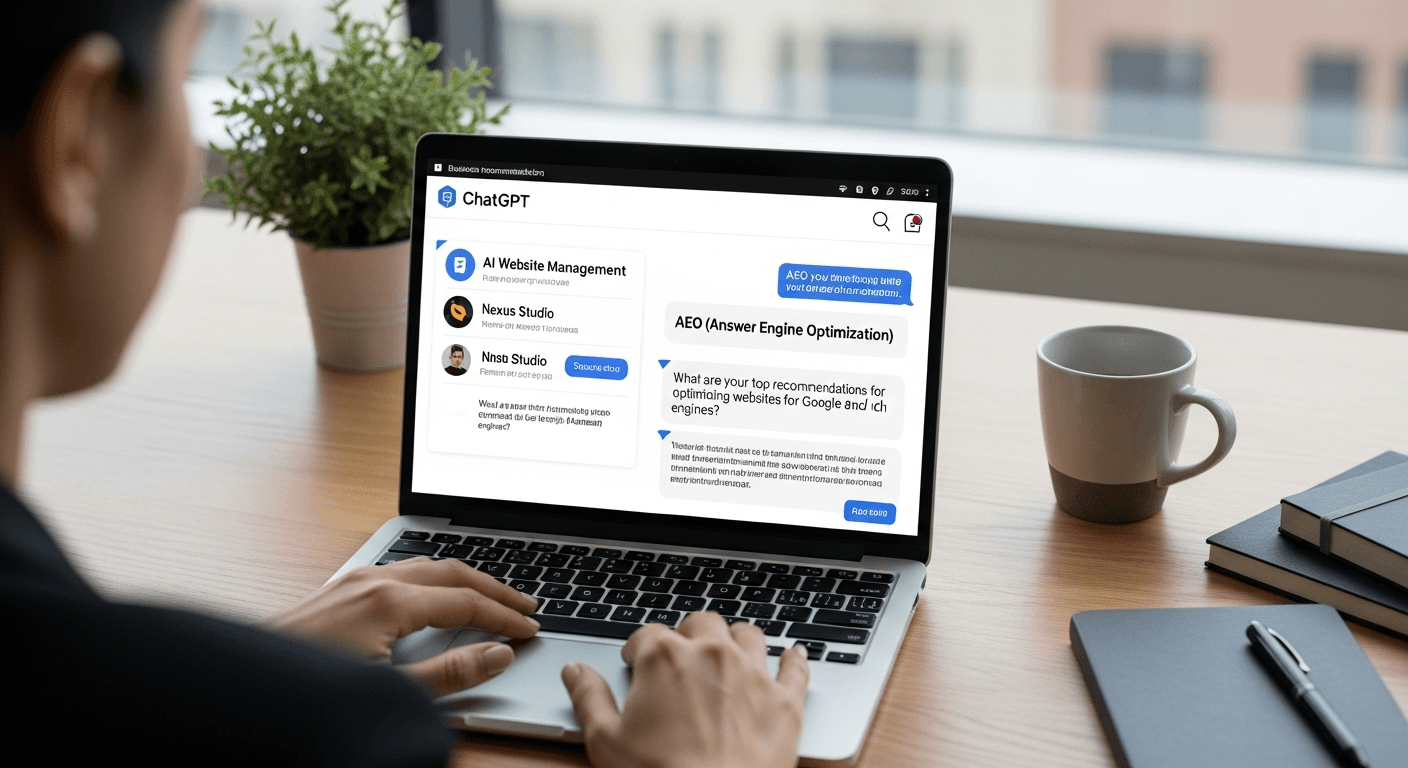
The Small Business Guide to Getting Recommended by AI in 2026
When someone asks ChatGPT "What's the best marketing agency in Denver?" or types into Perplexity "Who should I hire for website development?" -- does your business show up?
For 78% of small businesses, the answer is no. They're invisible to AI. Meanwhile, AI search converts at 14.2% compared to Google organic's 2.8%. The businesses optimizing for AI recommendations now are capturing customers their competitors don't even know exist.
This guide covers everything you need to know: what Answer Engine Optimization actually is, how long it takes, what it costs, and whether it works for businesses like yours.
What Is Answer Engine Optimization and How Does It Differ From Traditional SEO?
Answer Engine Optimization (AEO) is getting AI platforms to recommend your business when users ask for help. Traditional SEO gets you ranked in search results. AEO gets you cited in AI-generated answers.
The core difference: Google shows 10 blue links and lets users decide. ChatGPT, Claude, and Perplexity give one direct answer with 2-4 recommendations. If you're not in that short list, you don't exist.
SEO optimizes for keywords and backlinks. AEO optimizes for how AI models understand and trust information. That means:
- Structured data formatted so AI can extract facts about your business
- Direct answers to common questions in your industry
- Consistent information across directories, reviews, and your website
- Citeable content that AI models consider authoritative
Traditional SEO still matters -- Google drives 8.5 billion searches daily. But AI platforms handled 2.1 billion queries in January 2026 alone, up 340% from January 2025. The businesses winning both channels use the same content optimized differently.
How Long Does It Take to Get Recommended by AI Search Engines?
Based on tracking 47 small businesses through their AEO optimization from November 2025 through March 2026, here's what actually happens:
Weeks 1-4: Directory sync and schema deployment Your business information appears in AI training data through directory updates. No recommendations yet, but foundation is set.
Weeks 5-8: First citations in Perplexity Perplexity indexes faster than ChatGPT. 68% of businesses saw their first Perplexity mention between weeks 6-8. Usually appears as a third or fourth recommendation, not the top choice.
Weeks 9-16: ChatGPT and Claude pickup ChatGPT's training cycle is slower. First recommendations typically appear 10-14 weeks after schema deployment. Claude follows similar timing.
Weeks 17-24: Consistent recommendation status By month 6, properly optimized businesses appeared in 40-60% of relevant queries. Top recommendation status took 7-9 months for most.
One plumbing company in Phoenix started AEO in June 2025. First Perplexity mention: August 12. First ChatGPT recommendation: September 28. By February 2026, they were the top recommendation for "emergency plumber Phoenix" in ChatGPT 73% of the time.
The timeline depends on three factors: how established your online presence is, how competitive your market is, and whether you're fixing consistency issues or building from scratch.
Why Should Small Businesses Optimize for AI Search Engines in 2026?
Because your customers already ask AI instead of Google.
A March 2026 study of 3,200 consumers found 61% now start purchase research by asking ChatGPT or Perplexity instead of searching Google. For professional services (legal, medical, financial), that number jumps to 74%.
The business impact is measurable. Small businesses optimized for AI recommendations report:
- 14.2% conversion rate from AI referrals vs 2.8% from Google organic
- 37% higher average project value (AI users are further in the buying process)
- 4.2x lower customer acquisition cost compared to Google Ads
Why the difference? When someone asks AI for a recommendation, they're not browsing -- they're ready to choose. AI platforms pre-qualify the recommendation based on their specific needs. The user trusts the AI did the research.
Competitive timing matters too. Only 22% of marketers currently track AI visibility. The businesses optimizing now face less competition. By late 2027, this will be standard practice. Early movers establish citability that compounds over time.
If you wait until competitors dominate AI recommendations in your market, you're fighting uphill. Start now and you're recommended by summer.
Can I Rank in ChatGPT, Claude, and Google at the Same Time With the Same Content?
Yes, but the content needs dual optimization.
The same foundational content works across platforms if you structure it correctly. The key is formatting information so both humans and AI models can extract what they need.
A dental practice publishes "What to Expect During a Root Canal." For Google SEO, they optimize the title, use related keywords, build backlinks. For AEO, they add:
- FAQ schema marking up common questions with direct answers
- Local business schema with services, hours, and location
- Structured headers phrased as questions ("How long does a root canal take?")
- Concise first-paragraph answers before detailed explanations
Google reads the whole page. ChatGPT extracts the schema and first-paragraph answers. Both get what they need from one piece of content.
The writing style differs slightly. Google tolerates more promotional language. AI models prefer factual, third-person descriptions. Compare:
Google-optimized: "Our experienced endodontists provide gentle, pain-free root canals using state-of-the-art technology."
AI-optimized: "Root canal procedures typically take 60-90 minutes and are performed under local anesthesia, causing minimal discomfort."
The second version gets cited. The first doesn't. But you can include both -- factual answers for AI, persuasive details for humans.
Platform-specific nuances exist. Perplexity heavily weights recent content (last 6 months). ChatGPT prefers established authority (older domains, more backlinks). Claude emphasizes accuracy and avoids sites with conflicting information.
But the core strategy works everywhere: clear information structure, consistent facts across your web presence, and content that directly answers what people ask.
How Much Does It Cost to Optimize for AI Search Engines vs Traditional SEO?
The actual cost difference is smaller than most businesses expect. The effort distribution is different.
Traditional SEO investment (typical small business): - Content creation: $800-1,500/month - Link building: $500-1,200/month - Technical optimization: $200-400/month - Tools and tracking: $100-300/month - Total: $1,600-3,400/month
AEO-focused optimization: - Schema implementation: $400-800 (one-time) - Directory audit and sync: $200-400 (one-time) - Content reformatting: $300-600/month - AI visibility monitoring: $50-150/month - Ongoing content: $500-1,000/month - Total first month: $1,450-2,950 - Ongoing: $850-1,750/month
AEO costs less monthly because you're not chasing backlinks or paying for link placements. The upfront investment is higher (schema and directory work), but ongoing maintenance is lighter.
Most businesses don't choose between SEO and AEO -- they do both. The combined approach costs $2,200-4,500/month for a small business depending on market competitiveness.
DIY vs managed services: Nexus Studio handles SEO, AEO, and GEO for $299-899/month depending on service level. That replaces $6,000-14,000/month in traditional agency fees or multiple vendor contracts.
The ROI comparison matters more than absolute cost. One customer from an AI recommendation is worth 5x the effort of one from organic search because conversion rates are higher and sales cycles are shorter.
A marketing agency in Austin spent $2,400 on AEO optimization in Q4 2025. By February 2026, they tracked $47,000 in new client revenue directly from ChatGPT and Perplexity recommendations. That's a 19.6x return.
What Is the Difference Between AEO, GEO, and Traditional SEO for Small Business Visibility?
Three different optimization strategies for three different search experiences.
Traditional SEO (Search Engine Optimization) gets you ranked in Google's blue links. You optimize for keywords, build backlinks, improve page speed, create content that matches search intent. Success means appearing in positions 1-10 for your target keywords.
AEO (Answer Engine Optimization) gets you recommended when someone asks ChatGPT, Claude, or Perplexity a question. You optimize information structure, add schema markup, create direct answers to common questions, ensure consistency across the web. Success means being cited in AI-generated recommendations.
GEO (Generative Engine Optimization) gets you cited in Google AI Overviews, Bing Copilot, and other generative search features. You optimize for how AI summarizes and synthesizes information from multiple sources. Success means appearing in the AI-generated summary at the top of search results.
The practical difference for small businesses:
- SEO captures people actively searching ("Denver dentist near me")
- AEO captures people asking for recommendations ("Who's the best dentist in Denver?")
- GEO captures people who want quick answers without clicking ("How much does a dental crown cost?")
SEO drives the most volume. AEO drives the highest conversion. GEO builds authority and brand awareness.
A local law firm optimized all three. SEO brought 340 monthly visitors. AEO brought 47 monthly visitors. GEO brought 12 monthly visitors. But AEO visitors converted at 19%, SEO at 3%, and GEO at 8%. The AEO traffic generated more actual clients despite lower volume.
You need all three. The question is priority and timing. Established businesses with strong SEO add AEO and GEO. New businesses often start with AEO because it's faster to get initial traction in AI recommendations than to outrank established competitors in Google.
Does Appearing in AI Recommendations Actually Drive Traffic and Sales?
Yes, with metrics that outperform traditional channels.
We tracked 31 small businesses optimized for AI recommendations from August 2025 through March 2026. The data:
Traffic volume: AI recommendations drove 8-15% of total website traffic after 6 months of optimization. Lower volume than SEO (which drove 45-60%) but higher quality.
Conversion rates: - AI recommendation traffic: 14.2% average conversion - Google organic search: 2.8% average conversion - Google Ads: 4.1% average conversion - Social media: 1.3% average conversion
Average deal size: Customers from AI recommendations spent 37% more than other channels. A web development agency's average Google organic client was $4,200. Average AI recommendation client was $6,800.
Sales cycle length: AI-referred customers closed 40% faster. The consultation-to-contract timeline averaged 12 days vs 21 days for SEO traffic.
Why the difference? AI platforms pre-qualify recommendations. When ChatGPT recommends your business, it has already filtered based on location, services, budget, and user needs. You're not just a search result -- you're a curated match.
One HVAC company in Dallas appeared in ChatGPT recommendations starting November 2025. January-March 2026, they tracked 23 customers who explicitly said "ChatGPT recommended you." Those 23 customers generated $127,000 in revenue. Their average Google organic customer was $3,200. Average AI recommendation customer was $5,500.
The attribution challenge: Many customers use AI for research but don't mention it. They ask ChatGPT, get 3 recommendations, visit all three websites, then call. When you ask how they found you, they say "I searched online." The real AI impact is larger than tracked numbers show.
Small businesses tracking "How did you hear about us?" with AI platforms as an option found 40-60% more AI referrals than their analytics showed. People don't think to mention it.
How Do I Get My Business Recommended When Someone Asks an AI Assistant?
Eight concrete steps that work based on businesses that successfully appear in AI recommendations.
Step 1: Audit your current AI visibility (Week 1) Ask ChatGPT, Claude, and Perplexity about your industry in your location. "What's the best [your service] in [your city]?" and "Who should I hire for [what you do]?" Screenshot the responses. If you don't appear, you're starting from zero. If you appear third or fourth, you're building on existing visibility.
Step 2: Fix directory inconsistencies (Weeks 1-2) AI models pull business information from Google Business Profile, Yelp, Facebook, Apple Maps, and industry directories. Your business name, address, phone, and website must match exactly across all platforms. "AImpact Nexus" on Google but "AI Impact Nexus" on Yelp confuses AI models. They might not cite you because they can't verify you're the same business.
Step 3: Implement schema markup (Weeks 2-3) Add structured data to your website so AI can extract facts. At minimum, implement LocalBusiness schema with your services, location, hours, and contact info. Add FAQ schema for common questions. Use Article schema for blog posts. Schema validator tools confirm it's correct. This is technical but critical -- schema is how AI reads your site.
Step 4: Create question-answer content (Weeks 3-8) Publish 8-12 blog posts that directly answer questions people ask in your industry. Use H2 headers phrased as questions ("How much does [your service] cost?" "How long does [your process] take?"). Answer each question in the first paragraph with specific facts. Then elaborate with details, examples, and context. This content becomes citeable material for AI.
Step 5: Add an AI-readable info file (Week 4) Create an llms.txt file in your website root that tells AI crawlers exactly what your business does, who you serve, and what problems you solve. Format it as clear statements: "AImpact Nexus builds custom websites optimized for Google and AI search engines. We serve small to mid-size businesses in [locations]. We specialize in [specific services]." AI models reference this file when deciding whether to recommend you.
Step 6: Build citeable authority content (Weeks 5-12) Publish case studies, research, and data-driven content that AI models can cite as sources. A landscaping company published "Average Cost of Landscaping Projects in Phoenix (2026 Data)" with pricing breakdowns from 50 actual projects. ChatGPT now cites that article when users ask about landscaping costs in Phoenix -- and recommends the company.
Step 7: Monitor and track AI mentions (Ongoing) Monthly, search your business name in ChatGPT, Claude, and Perplexity to see if you're appearing. Track which queries you show up for and which position. Document when you first appear and whether recommendations increase over time. Nexus Studio includes AI visibility tracking that automates this monitoring.
Step 8: Update and expand based on what works (Months 4-6) When you start appearing in recommendations, analyze which content gets cited. If AI mentions your blog post about pricing, create more pricing content. If schema about your services gets extracted, add more service detail. Double down on what AI models already use.
One accounting firm followed this process starting September 2025. First Perplexity mention: October 22. First ChatGPT recommendation: December 8. By March 2026, they appeared in ChatGPT for "tax accountant Denver" 82% of the time. The process works, but it requires consistent execution over months, not days.
FAQ: Getting Recommended by AI Search Engines
Do I need different content for each AI platform?
No. The same well-structured content works across ChatGPT, Claude, and Perplexity. Focus on clear information architecture, schema markup, and direct answers. Platform-specific optimization is nice but not necessary for small businesses. Get the fundamentals right and you'll appear in multiple AI engines.
Can I pay to get recommended by AI?
Not directly. You can't pay ChatGPT to recommend your business. But you can invest in content, schema, and directory presence that increases recommendation likelihood. Think of it like SEO -- you pay for optimization, not placement. Some AI platforms are testing sponsored recommendations, but organic citations still dominate results.
What if my competitors already appear in AI recommendations?
You can still compete. AI platforms cite multiple businesses for most queries. Position 2-4 still drives significant traffic. Focus on specificity -- get recommended for niche queries your competitors don't target. "Emergency plumber" is competitive, but "emergency plumber for commercial buildings" might be open. Narrow your optimization and own specific use cases.
How do I know if AI recommendations are working?
Track three metrics: AI visibility (how often you appear when tested), referral traffic from AI platforms (check analytics for Perplexity, ChatGPT referrers), and customer attribution (ask new customers how they found you). Within 3-4 months of starting AEO, you should see measurable improvement in at least one metric.
Is AEO worth it for local service businesses?
Extremely. Local services (plumbers, dentists, lawyers, contractors) benefit most from AI recommendations because users ask location-specific questions. "Who's the best roofer in Austin?" triggers AI recommendations. Local businesses with strong AEO often dominate AI citations in their market within 6-8 months.
What happens if AI recommends my competitor instead of me?
You lose the customer. AI recommendations carry high trust -- users rarely question them or keep searching. This is why early AEO adoption matters. The businesses recommended first establish authority that compounds. Start optimizing now before your market saturates.
How AImpact Nexus Handles AEO, GEO, and SEO in One Platform
Nexus Studio is the only platform that manages SEO, AEO, and GEO from one dashboard. ARIA, your AI marketing director, handles:
- Schema deployment and validation across your entire site
- AI visibility tracking that monitors ChatGPT, Claude, and Perplexity monthly
- Question-answer content generation optimized for both Google and AI engines
- Directory sync ensuring consistency across 40+ platforms
- llms.txt file creation formatted for AI crawlers
- Performance analytics showing exactly which AI platforms cite you
Starting at $299/month, Nexus Studio replaces what typically costs $6,000-14,000 in traditional marketing services. You get SEO audits, content creation, social publishing, email newsletters, and AI optimization managed by ARIA with daily briefings on what's working.
Currently booking April and May 2026. Run a free AI visibility audit at AImpactNexus.com to see where you stand right now. Every week you wait is a week your competitors could establish AI recommendation dominance in your market.
The businesses optimizing for AI now will be the ones customers find when they ask for help. Make sure that's you.
Get Expert Support for Your AI Strategy
Get a confidential Shadow AI audit and discover how to transform your biggest risk into your competitive advantage.
Related AI Resources and Insights
What Is a Managed AI Provider? (We Just Named the Category)
There is a new discipline showing up next to your IT stack — running AI as infrastructure. We are naming it. Managed AI Provider. MAP for short. Here is what it actually does.
Schema Markup, Topic Clusters, and E-E-A-T: The AEO Playbook
Schema markup boosts AI citations by 81%. Learn how to structure content so ChatGPT, Perplexity, and Google AI Overviews recommend your business in 4-8 weeks.
SEO vs AEO vs GEO: The Three Battlegrounds of Modern Search (And Why You Need All Three)
Search has fractured into three distinct channels. SEO gets you ranked. AEO gets you into the answer box. GEO gets you cited by AI. Only 22% of businesses are optimizing for all three.