AI for Indiana Manufacturers: Where It Pays Off First
Skip the robot fantasies. Start AI in manufacturing with quoting, maintenance, quality paperwork and the ERP data you already have.

CTO & Founder, The Fort AI Agency
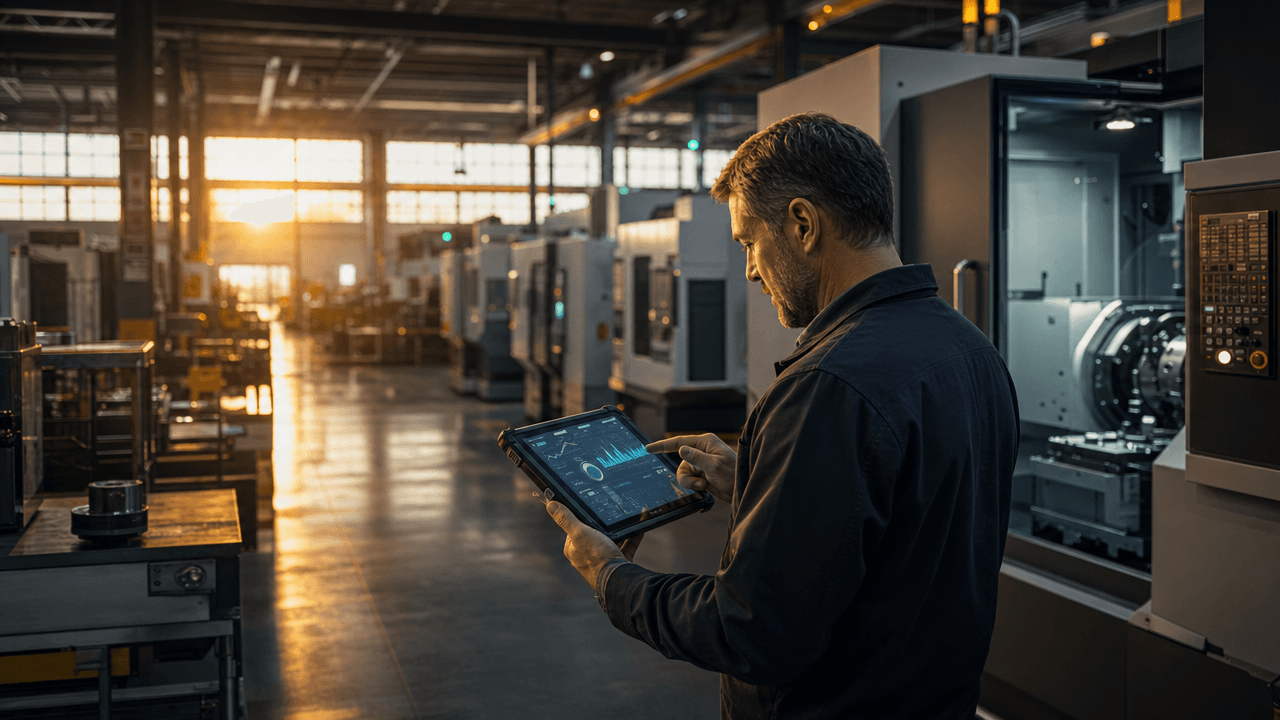
If you run a machine shop in Fort Wayne, a fab shop in Elkhart, or a plastics plant somewhere along I-69, you've heard plenty of AI pitches by now. Most of them show off lights-out factories and humanoid robots. Your actual problem is probably that quotes take too long, and only one guy knows how to fix the old press brake.
This guide is about AI for Indiana manufacturers as it works in November 2026. It covers where AI pays off first, where a small manufacturer should start, and whether AI can work with the ERP data you already have. Andy Oberlin, founder of The Fort AI Agency, spent 20 years running an MSP and supporting businesses across Northeast Indiana. That includes a lot of time on plant floors, working around machines older than the people running them.
Short version: AI pays off first in the office, not on the floor.
Key Takeaways
- AI in manufacturing pays off first in paperwork-heavy work like quoting, quality documentation, maintenance records and ERP reporting. Robotics and computer vision come later.
- Small manufacturers should start with one painful, repetitive workflow, not a company-wide AI strategy deck.
- AI can work with your ERP data. Systems like Epicor, Plex, Global Shop Solutions, JobBOSS, SAP Business One, NetSuite and Microsoft Dynamics 365 Business Central all export or expose data that AI tools can read.
- Dirty data is the real blocker, not the AI. Cleaning up part numbers, routings and customer records is often the most valuable early project.
- Tribal knowledge is your biggest risk and one of the best AI opportunities. AI can capture what your veterans know before they retire.
- Security comes first. Never paste controlled, ITAR or customer-confidential drawings into consumer AI tools. Use business-tier tools with data protections.
- Indiana has real support available, including Purdue MEP and Conexus Indiana, for manufacturers modernizing operations.
How are manufacturers using AI in 2026?
In 2026, most manufacturers use AI to speed up knowledge work around production, not to replace the production itself. The common uses are drafting quotes, summarizing maintenance history, writing and checking quality documentation, answering questions about ERP data in plain English, and training new hires. The flashy uses, like autonomous robots and full digital twins, are real but mostly limited to large plants with big engineering teams.
Here's what the practical adoption looks like on the ground:
- General-purpose AI assistants like Microsoft 365 Copilot, ChatGPT Enterprise and Claude are used for drafting, summarizing and analysis by office, engineering and quality staff.
- AI features built into ERPs and MES platforms. Vendors like Epicor, Rockwell Automation (Plex) and SAP have all been adding AI assistants to their products. If you're on a current version, you may already be paying for capabilities nobody has turned on.
- Analytics with natural-language querying. Tools like Microsoft Power BI with Copilot let a plant manager ask what the scrap trend on a part family looks like without writing a report.
- Predictive maintenance on critical assets. Sensor-based monitoring works, but it makes the most sense on equipment where downtime is truly expensive.
- Vision-based quality inspection. This is proven technology, but it's a capital project. It isn't where you start.
A thread on the Hacker News front page this week asked whether the web is being rebuilt for machines through things like llm.txt files. Manufacturers face the same shift. AI tools are only as useful as the information you can feed them. A shop whose knowledge sits in spreadsheets, PDFs and one person's head isn't ready yet. A shop with organized data is.
Where AI for Indiana Manufacturers Pays Off First
After years of walking plant floors and server closets around Northeast Indiana, Andy Oberlin's view is simple: start where your skilled people spend time on work that isn't their skill. Your estimator should be estimating, not searching old jobs. Your quality manager should be improving processes, not formatting reports.
These are the five areas where AI usually delivers value first.
1. Quoting and Estimating
Quoting is a bottleneck in almost every job shop. The estimator digs through old jobs, compares material and routings, and builds a number from experience. When that person is on vacation, quotes stall.
AI helps by:
- Finding similar past jobs based on part description, material, tolerances and quantities
- Summarizing RFQ packages, including long customer specs, terms and conditions, and flowed-down requirements
- Flagging risk items like unusual certifications, tight tolerances or penalty clauses buried on page 40
- Drafting the quote letter and exceptions list for the estimator to review
The AI doesn't set your price. Your estimator does. AI just gets them to the decision faster, with better information.
2. Maintenance Knowledge and Work Orders
Every plant has the guy who knows that machine number 7 needs a specific trick when it throws a certain fault. When he retires, that knowledge leaves with him.
AI can:
- Search your maintenance history in plain English. Ask what fixed the hydraulic leak on the stamping press last time.
- Summarize OEM manuals that run hundreds of pages
- Turn rough technician notes into clean, searchable work order records
- Spot recurring failures across work orders that nobody has had time to connect
This is one of the easiest early wins because the data usually already exists. It's just buried.
3. Quality Documentation
If you're ISO 9001, IATF 16949 or AS9100 certified, you know how much of quality is paperwork: corrective actions, 8Ds, PPAP packages, control plans, work instructions and audit prep.
AI can:
- Draft corrective action reports from investigation notes
- Check documents for consistency, like a control plan that doesn't match the PFMEA
- Convert procedures into clear work instructions, including versions in Spanish or other languages your workforce speaks
- Prepare audit summaries from your existing records
Your quality manager still owns every document. AI takes over the blank page and the formatting.
4. ERP Reporting and Answers
Most small manufacturers have years of valuable data in their ERP and very little time to analyze it. Getting a custom report often means waiting on the one person who knows how to write it, or paying a consultant.
AI-assisted reporting lets you ask questions like:
- Which customers have had the most late shipments this year?
- Which part numbers have quoted margins that don't match actual job costs?
- Where are we buying the same material from three different suppliers?
More on this below, because it's one of the most common questions we hear.
5. Training and Onboarding
Hiring is hard across Indiana manufacturing, and new people need to get productive fast. An internal AI assistant trained on your work instructions, safety procedures and handbook gives new hires somewhere to ask the questions they're embarrassed to ask a supervisor.
This doesn't replace mentorship on the floor. It means your best operators get asked fewer basic questions.
Where Should a Small Manufacturer Start with AI?
A small manufacturer should start with one repetitive, painful, office-side workflow, run a short pilot with business-grade tools, and measure the result before expanding. The best first projects are usually quoting support, maintenance knowledge search or quality documentation. Don't start with a plant-wide AI strategy, and don't start with a robot.
Here's the process The Fort AI Agency uses with manufacturing clients:
- Pick the bottleneck. Ask your department leads where work piles up or where only one person knows how to do something. That's your shortlist.
- Check the data. Find out where the information for that workflow lives. It could be the ERP, a shared drive, a filing cabinet or someone's memory. If it's in a filing cabinet, digitizing it is step one.
- Lock down security first. Decide which AI tools are approved and what data is allowed in them. Put it in writing before anyone starts experimenting with customer drawings.
- Run a focused pilot. Pick one team and one workflow, and set a few weeks of honest use. Get feedback from the people actually doing the work.
- Measure what matters. Compare quote turnaround, report prep effort or time to find answers before and after. If you can't measure the improvement, you can't justify expanding.
- Expand or kill it. If it worked, roll it out to the next workflow. If it didn't, figure out why. Usually the cause is the data or the process, not the AI.
What Your Team Is Already Doing
Your people are probably already using free AI tools on personal accounts, whether you know it or not. That's the real risk. An approved, business-grade tool with a clear policy is far safer than pretending nobody uses AI.
Can AI Work with My ERP Data?
Yes, AI can work with your ERP data, but how well it works depends on how clean that data is and how you connect it. Most modern ERPs used by Indiana manufacturers, including Epicor Kinetic, Plex, Global Shop Solutions, JobBOSS, SAP Business One, NetSuite and Dynamics 365 Business Central, support data exports, reporting databases or APIs that AI tools can use. The connection is rarely the hard part. The data quality usually is.
Three Ways to Connect AI to Your ERP
- Built-in AI features. Many ERP vendors now include AI assistants in current versions. Check with your vendor or reseller about what you're licensed for. This is the lowest-risk option.
- Reporting layer with AI. Push ERP data into a reporting tool like Power BI and use natural-language features on top. Your ERP stays untouched and read-only.
- Custom integration. Connect an AI model to your ERP through its API or a read-only database view, set up with proper access controls. This is the most flexible option and needs someone who understands both IT security and manufacturing data.
The Dirty Data Problem
Here's the part nobody selling AI wants to talk about. If your ERP has duplicate part numbers, routings nobody updated since the last owner, inconsistent customer names and job costs that never got closed out, AI will confidently give you wrong answers.
The good news is that AI is also very good at finding dirty data. It can flag likely duplicates, inconsistent units of measure and stale records much faster than a person scrolling through spreadsheets. For many shops, data cleanup is the most valuable first AI project, even though it's the least exciting.
A Note on Older Systems
If you're running a heavily customized ERP version from years ago on a server in a closet, you can still use AI. You'll probably work from scheduled exports instead of live connections. Andy's MSP background matters here: The Fort AI Agency has seen plenty of legacy systems, and they can almost always be worked around without ripping anything out.
What to Skip (For Now)
Not every AI idea belongs in a small or mid-sized plant this year. Hold off on:
- Fully autonomous scheduling. AI can suggest schedules and flag conflicts, but your scheduler knows things the system doesn't, like which customer will actually pick up the phone.
- Plant-wide digital twins, unless you have the engineering staff and sensor infrastructure to support them.
- Vendors promising to replace people. In a tight labor market, the goal is helping the team you have do more valuable work.
- Anything that needs your controlled data in a consumer tool. No exceptions.
Security, Compliance and Doing This Ethically
Many Indiana manufacturers supply defense, aerospace, automotive and medical customers. That brings obligations like ITAR, CMMC requirements for defense supply chain work, and customer confidentiality agreements.
The basics:
- Classify your data. Know what's controlled, what's confidential and what's general business information.
- Use business or enterprise AI tiers whose terms state that your data isn't used to train public models.
- Keep a human in the loop on anything that goes to a customer, affects quality, or touches safety.
- Tell your workforce what you're doing and why. People handle AI much better when leadership explains that the goal is to remove grunt work, not jobs.
This is the ethical AI implementation The Fort AI Agency is built around. Good AI adoption should make your people's jobs better, and should never put your customer relationships at risk.
Indiana Manufacturers Have an Edge
Indiana is one of the most manufacturing-intensive states in the country, and there's an ecosystem to match. Purdue MEP works directly with small and mid-sized manufacturers on modernization. Conexus Indiana focuses on advanced manufacturing and logistics across the state. Regional economic development groups in Northeast Indiana actively support manufacturers.
You don't have to figure this out alone. You also don't need a big consulting firm from Chicago or Indianapolis to tell you what an Indiana plant floor looks like.
Frequently Asked Questions
How are manufacturers using AI in 2026?
Manufacturers in 2026 mostly use AI for knowledge work: quoting support, maintenance history search, quality documentation, ERP reporting and employee training. Larger plants also use AI for predictive maintenance and vision-based inspection. For small and mid-sized shops, the fastest returns come from office-side workflows.
Where should a small manufacturer start with AI?
Start with one repetitive, high-friction workflow, such as quoting, maintenance knowledge or quality paperwork. Set security rules first, run a short pilot with business-grade tools, measure the result, and only then expand. Don't start with robotics or a company-wide AI overhaul.
Can AI work with my ERP data?
Yes. Most modern ERPs, including Epicor, Plex, Global Shop Solutions, JobBOSS, SAP Business One, NetSuite and Dynamics 365 Business Central, support exports, reporting databases or APIs that AI can use. The bigger challenge is data quality, so cleaning up part numbers, routings and customer records often comes first.
Is it safe to use ChatGPT or Claude with customer drawings?
Not with free consumer accounts, and never with ITAR-controlled or CMMC-covered data unless the environment is specifically approved for it. Use business or enterprise tiers with clear data protection terms, and set a written policy on what data is allowed in which tools.
Will AI replace workers in Indiana manufacturing plants?
For most small and mid-sized manufacturers, the practical use of AI is helping existing staff spend less time on paperwork and searching for information. With skilled labor already hard to find, the realistic goal is getting more value from the team you have, not shrinking it.
Ready to Find Your First AI Win?
AI for Indiana manufacturers isn't about chasing hype. It's about finding the one workflow where your best people are stuck doing work below their skill level, and fixing it with tools that are secure, measurable and built for how your plant actually runs.
The Fort AI Agency is based in Fort Wayne and led by Andy Oberlin, who brings 20 years of hands-on IT experience to every engagement. We'll walk your operation, look at your ERP and your data, and tell you honestly where AI will pay off and where it won't.
Schedule a free consultation at thefortaiagency.ai and let's find your first win.
Want this working in your business?
Book a free 30-minute call. If it's a fit, we come on site and give you a written plan for what to automate first.
Related AI Resources and Insights
AI for HVAC and Plumbing Companies: Booking, Dispatch, Follow-Up
AI for HVAC and plumbing companies handles after-hours calls, booking, dispatch and follow-up. Here's what works, what it costs, and where to start first.
AI Chatbots vs AI Agents: What's the Actual Difference?
Confused about AI chatbots vs AI agents? Learn the real difference, what AI agents can do that chatbots can't, and which one your business should use in 2026.
Why Indiana Businesses Need AI Now: A Local Perspective on Implementation
Indiana businesses are rapidly adopting AI tools for everything from automation to customer service. Local expert Andy Oberlin explains why waiting isn't an option in 2026.