AI Chatbots vs AI Agents: What's the Actual Difference?
One answers questions. The other gets work done. Here's how to know which your business actually needs.

CTO & Founder, The Fort AI Agency
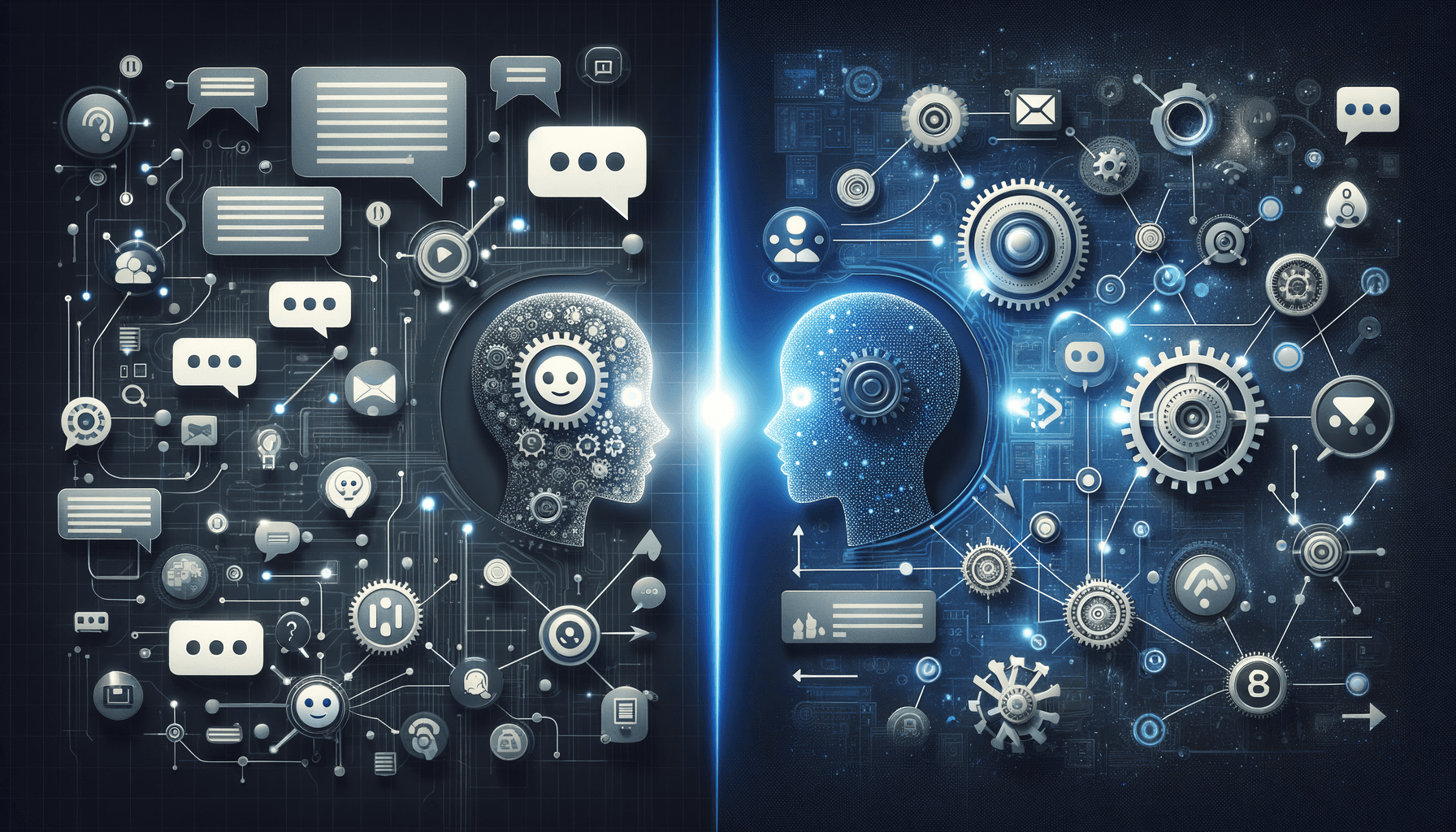
AI Chatbots vs AI Agents: What's the Actual Difference?
Every business owner I talk to these days uses the words "chatbot" and "AI agent" like they're the same thing. They're not. And the confusion is costing companies real money — either by buying expensive agent platforms when a simple chatbot would do, or by deploying a glorified FAQ bot and wondering why it can't actually do anything.
I'm Andy Oberlin. I ran a managed services provider (MSP) for two decades before starting The Fort AI Agency here in Fort Wayne, Indiana. I've watched this exact confusion play out dozens of times. So let's clear it up — no jargon, no hand-waving.
The short version: a chatbot talks, an AI agent acts. Now let's get into the details that actually matter for your business.
What Is the Difference Between an AI Chatbot and an AI Agent?
An AI chatbot is a conversational tool that responds to user messages with text — it answers questions and retrieves information but cannot take independent action. An AI agent is an autonomous system that can reason, plan, use tools, and complete multi-step tasks on its own without you spelling out every step.
Think of it this way: a chatbot is a really smart receptionist who can answer any question you ask. An AI agent is an employee you can hand a goal to — "book me the cheapest flight to Chicago next Tuesday" — and it'll go check the airlines, compare prices, and actually make the booking.
The difference comes down to three things:
- Chatbots respond. Agents act. A chatbot generates a reply. An agent executes tasks across multiple systems.
- Chatbots are reactive. Agents are proactive. A chatbot waits for your next message. An agent can chain steps together, recover from errors, and keep going until the job is done.
- Chatbots have no tools. Agents do. Agents can call APIs, query databases, send emails, update your CRM, and trigger workflows. A standard chatbot just talks.
A Quick Real-World Comparison
Say a customer messages your business at 11 PM asking to reschedule an appointment.
A chatbot says: "To reschedule, please call us during business hours or visit this link."
An AI agent says: "I see you're booked for Thursday at 2 PM. Want me to move you to Friday at 10 AM? Done — confirmation sent to your email." Then it actually updates your calendar, notifies the staff, and logs the change in your system.
Same customer, same question, completely different outcome. One deflects. One resolves.
What Can AI Agents Do That Chatbots Can't?
AI agents can complete multi-step tasks autonomously by reasoning through a goal, using external tools and APIs, and adapting when something goes wrong. Chatbots are limited to generating conversational responses and cannot independently take actions in your business systems.
Here's what agents bring to the table that chatbots simply can't:
- Tool use. Agents connect to your software — Salesforce, QuickBooks, Google Workspace, your scheduling system — and actually operate them. This is the single biggest leap.
- Multi-step reasoning. Give an agent a goal and it figures out the steps. "Onboard this new client" might trigger seven different actions across five systems. An agent handles the whole sequence.
- Memory and context. Modern agents remember past interactions and carry context across sessions, so they don't make your customers repeat themselves.
- Error recovery. When an API fails or data is missing, a good agent tries another approach instead of just dying. Chatbots have no concept of "recovering."
- Autonomous workflows. Agents can run on a schedule or trigger — monitoring your inbox, flagging issues, drafting responses — without anyone prompting them.
There's a fascinating trend bubbling up right now that proves where this is headed. On Hacker News this week, there's an active discussion called "Is the web for machines (/llm.txt) the one we wished we had as humans?" — referencing the growing push to build web standards specifically so AI agents can navigate and act on websites. We're literally restructuring the internet to be machine-readable because agents are about to become primary users of it. Chatbots never created that kind of pressure.
Another HN thread this week — "Open Code Review, an AI-powered code review CLI tool" — is a perfect example of the agent shift in action. It's not a bot you chat with; it's a tool that autonomously reviews code, spots problems, and suggests fixes. That's the agent model: do the work, don't just talk about it.
Should My Business Use an AI Chatbot or an AI Agent?
Your business should use an AI chatbot if your main goal is answering common questions, deflecting support tickets, or guiding website visitors. You should use an AI agent if you need to automate actual workflows — booking, processing, updating systems, or completing tasks end-to-end without human intervention.
Let me make this dead simple. Ask yourself one question: Do I need this AI to answer, or do I need it to do?
Use a Chatbot When:
- You're fielding repetitive customer questions (hours, pricing, policies)
- You want to qualify leads before a human steps in
- You need 24/7 first-line support without hiring a night shift
- Your interactions end with information, not action
- You're on a tight budget and want fast ROI
Use an AI Agent When:
- You want to automate a process that touches multiple systems
- Your team wastes hours on repetitive copy-paste-and-update work
- You need the AI to actually complete transactions or bookings
- You're scaling and can't keep throwing humans at operational tasks
- The value is in doing the work, not just answering questions
Here's the honest truth most consultants won't tell you: most small businesses should start with a chatbot and graduate to an agent. A chatbot delivers value in weeks. An agent requires more integration work, more guardrails, and more testing. At The Fort AI Agency, I usually recommend businesses prove the concept with a focused chatbot, then expand into agentic automation once they trust the foundation.
Don't let a vendor sell you a $50,000 "autonomous AI agent platform" when what you actually need is a sharp chatbot answering your top 20 customer questions.
The Gray Area: When Chatbots Become Agents
The line is blurring fast, and this is where it gets interesting. Modern "chatbots" built on tools like OpenAI's GPT-4o, Anthropic's Claude, or Google's Gemini can be given tool access, turning them into lightweight agents.
The technology stack is the same — large language models doing the reasoning. The difference is what you connect them to and how much autonomy you grant.
A chatbot with read-only access to your FAQ database is still a chatbot. Connect that same model to your scheduling API with permission to create and modify bookings, and you've got an agent. The model didn't change. The capability and the risk did.
This is exactly why I push hard on AI governance with every client. The moment an AI can take action, it can take a wrong action. An agent that books appointments can also double-book, cancel the wrong thing, or send an email to the wrong customer. You need guardrails, logging, and human-in-the-loop checkpoints for anything high-stakes.
How Andy Oberlin Thinks About Choosing
After 20 years in IT, I've developed a simple framework I walk clients through at The Fort AI Agency:
- Map the task. Is this purely informational, or does it require action in a system?
- Count the steps. One-and-done answer = chatbot territory. Multi-step process = agent territory.
- Assess the risk. What happens if the AI gets it wrong? High-risk actions need agents with strong guardrails — or a human approval step.
- Calculate the ROI. A chatbot deflecting 40% of support tickets pays for itself fast. An agent automating a 10-step onboarding process can save dozens of hours weekly — but costs more to build right.
- Start small, prove it, scale it. Don't boil the ocean. Pick one workflow, nail it, then expand.
The businesses that win with AI in 2026 aren't the ones with the fanciest tech. They're the ones who matched the right tool to the right job and built it on a solid foundation.
Key Takeaways
- A chatbot talks; an AI agent acts. That's the core difference in one sentence.
- Chatbots answer questions and retrieve info. They're reactive and don't take independent action in your systems.
- AI agents reason, plan, use tools, and complete multi-step tasks autonomously — they actually do the work.
- Use a chatbot for FAQs, lead qualification, and 24/7 support. Use an agent for automating real workflows across multiple systems.
- Most businesses should start with a chatbot and graduate to agents once they trust the foundation.
- The same LLM can be either — the difference is tool access and granted autonomy.
- Agents require governance. When AI can take action, it can take wrong actions — guardrails are non-negotiable.
Frequently Asked Questions
Is an AI agent just a more advanced chatbot?
Not exactly. An AI agent often uses the same underlying language model as a chatbot, but it's given tools, autonomy, and the ability to take actions in real systems. A chatbot generates conversation; an agent executes tasks. The capability gap is significant even when the core technology is similar.
Are AI agents more expensive than chatbots?
Generally yes. AI agents require integration with your business systems, careful testing, guardrails, and ongoing monitoring, which makes them more expensive to build and maintain than a chatbot. However, agents can also deliver far higher ROI by automating labor-intensive workflows rather than just answering questions.
Can a chatbot be upgraded into an AI agent later?
Yes. Because both are typically built on the same large language models, you can extend a chatbot into an agent by connecting it to tools and APIs and granting it permission to take actions. At The Fort AI Agency, this staged approach — chatbot first, agent later — is exactly what we recommend for most small and mid-sized businesses.
What are the risks of using AI agents?
The main risk is that agents take real actions, so a mistake can have real consequences — double-booking appointments, sending wrong emails, or modifying data incorrectly. This is why AI governance, logging, and human-in-the-loop checkpoints are essential for any high-stakes agent. Andy Oberlin builds these guardrails into every agent deployment.
Which is better for customer service, a chatbot or an AI agent?
For answering common questions and deflecting tickets, a chatbot is fast and cost-effective. For resolving issues end-to-end — rescheduling, processing refunds, updating accounts — an AI agent delivers a far better customer experience because it actually solves the problem instead of redirecting the customer. Many businesses use a hybrid: a chatbot front-end with agent capabilities behind it.
Ready to Figure Out What Your Business Actually Needs?
Don't waste money on the wrong tool. Whether you need a lean chatbot to handle customer questions or a full AI agent to automate your operations, the right answer depends on your specific workflows — and getting it wrong is expensive.
That's exactly what we do at The Fort AI Agency. As a former MSP owner with 20 years of IT experience, I help businesses implement AI ethically, strategically, and on a foundation that won't fall apart six months later.
Schedule a free consultation at thefortaiagency.ai and let's map out whether a chatbot, an agent, or a combination of both will move the needle for your business. No pressure, no jargon — just a straight conversation about what'll actually work.
Get Expert Support for Your AI Strategy
Get a confidential Shadow AI audit and discover how to transform your biggest risk into your competitive advantage.