The Missing Piece in Your AI Strategy
Your APIs timeout. Your AI times out. Your infrastructure can't feed context fast enough for AI to be useful.

Enterprise AI Implementation Specialists
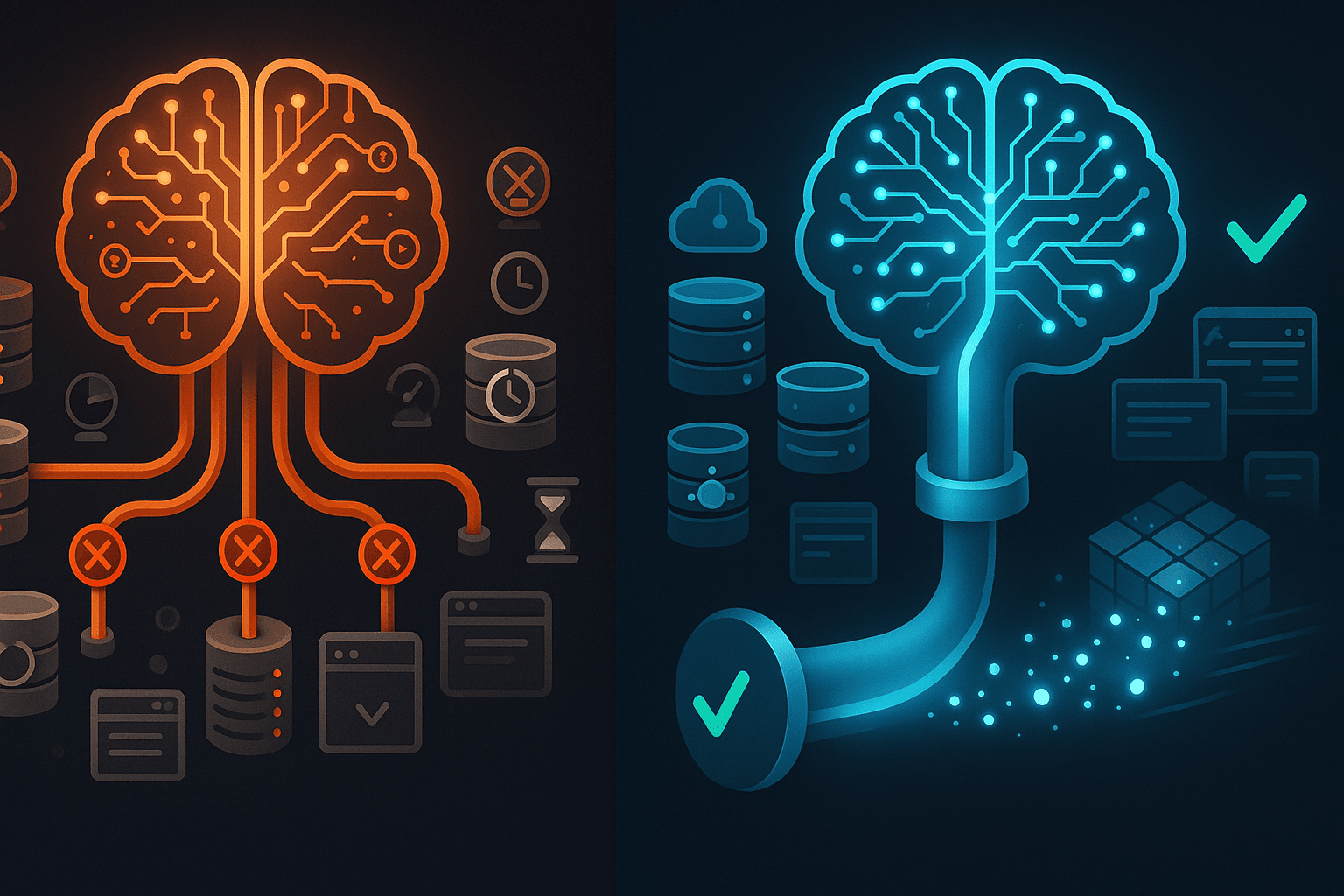
Here's what happens when you try 👇
Everyone's rushing to "add AI" to their systems. ChatGPT integrations. AI assistants. Smart features everywhere.
But here's the truth nobody talks about: You can't actually leverage AI's full capability without rebuilding your backend first.
Your APIs timeout. Your AI times out. Your infrastructure can't feed context fast enough for AI to be useful.
The AI revolution isn't being held back by the AI. It's being held back by the infrastructure trying to feed it.
The Impossible Math of AI-on-Legacy-Infrastructure
Let's talk about what actually happens when you try to "add AI" to a traditional backend:
Your sales rep asks AI: "Analyze this account and recommend an approach"
What AI needs: Complete account history (CRM) Past deal patterns (CRM archives) Similar successful deals (historical data) Competitive intelligence (multiple sources) Decision maker profiles (LinkedIn + internal notes) Product usage patterns (analytics database)
What happens with traditional infrastructure:
Minute 1: API call to CRM → 3-5 second response Minute 2: API call to analytics → 4-6 second response Minute 3: API call to data warehouse → timeout (dataset too large) Minute 4: Retry with smaller query → 8 seconds Minute 5: Try to assemble context for AI → partial data only Minute 6: Feed partial context to AI → AI hallucinates missing pieces Minute 7: AI times out because context assembly took too long Minute 8: Give up, ask a simpler question with less context
Result: Your "AI solution" is dumber than the human it's supposed to help.
Not because the AI isn't powerful. Because your infrastructure can't feed it fast enough.
Why Traditional APIs Can't Support Real AI
Here's the uncomfortable truth: APIs were built for humans, not AI.
Human workflow: Request one thing Wait a few seconds Look at result Request next thing Repeat
AI workflow: Request 50 things simultaneously Need response in <100ms (before context window fills) Correlate results instantly Feed into reasoning engine Generate next 50 requests based on findings Repeat 100x per second
Your REST APIs literally cannot keep up.
❌ Rate limits: AI hits your API limits in seconds ❌ Timeout limits: Complex queries exceed 30-second timeouts ❌ Sequential calls: AI needs parallel data, APIs return serial ❌ Incomplete context: By the time data arrives, AI's context is stale ❌ Cost explosion: API calls × AI requests = budget nightmare
This is why every "AI integration" you've tried feels underwhelming.
The Context Assembly Bottleneck
Here's what nobody tells you about AI:
Modern LLMs can reason over 200,000 tokens of context. That's roughly: 500 patient records, or 200 customer support tickets, or 100 legal case precedents, or 50 detailed sales opportunities
But your infrastructure can't assemble that context before AI times out.
The real workflow:
AI asks: "Show me patterns across similar customers"
Traditional backend must: 1. Query database for similar customers (5-10 seconds) 2. For each customer, fetch history (3-5 seconds × 50 customers = 150-250 seconds) 3. Fetch related records (another 100+ seconds) 4. Try to return to AI → timeout 5. Reduce scope → fetch only 10 customers 6. Return incomplete context 7. AI makes decision on 20% of relevant data
AI timeout: 30-60 seconds Context assembly: 5-10 minutes (if it doesn't fail)
This is why AI "can't see the full picture." It literally can't. Your infrastructure won't let it.
The Real AI Infrastructure Requirements
If you want AI that actually works, here's what you ACTUALLY need:
Layer 1: Pre-Computed Vector Intelligence → Not databases that AI queries → Knowledge already embedded and indexed → Similarity search in <50ms, not 5 minutes → Context assembled BEFORE AI asks
Layer 2: Semantic Cache → Not API response caching → Pre-analyzed relationships and patterns → AI gets pre-correlated context, not raw data → Nothing computed on-demand
Layer 3: Parallel Context Assembly → Not sequential API calls → All relevant data fetched simultaneously → Unified context delivered in single response → <100ms total assembly time
Layer 4: AI-Native Query Engine → Not SQL translated to embeddings → Native vector operations → Understands semantic relationships → Returns relevance-ranked results
Without these layers, you're not using AI. You're using expensive autocomplete on incomplete data.
Why "Just Add ChatGPT API" Fails
Everyone thinks: "We'll just call ChatGPT API with our data!"
What actually happens:
``` Reality Check: 1. User asks complex question 2. Your code tries to fetch relevant data 3. API calls take 30+ seconds 4. Context partially assembled 5. Send to ChatGPT API 6. ChatGPT response: 20-30 seconds 7. Total time: 50-60 seconds 8. User has given up and moved on
Cost Check: - ChatGPT API: $0.01-0.03 per 1K tokens - Your query needs 50K tokens of context - = $0.50-1.50 per question - × 1,000 questions/day - = $500-1,500/day - = $15K-45K/month just in API costs
Quality Check: - You sent partial context (APIs timed out) - ChatGPT fills gaps with hallucinations - User gets confidently wrong answers - Trust in AI solution destroyed ```
This is why 80% of enterprise AI projects fail. Not because AI doesn't work. Because infrastructure can't support it.
The "AI-Ready" Backend Architecture
At AImpact Nexus and The Fort AI Agency, we built infrastructure that actually works with AI:
Pre-Analysis Engine: → AI analyzes ALL data overnight → Embeddings pre-computed for every entity → Relationships mapped and indexed → Patterns identified and cached → When AI asks, context is already assembled
Vector Cache Layer: → Semantic search returns in 47ms → Top 100 relevant items instantly → Pre-ranked by relevance → Complete context, not fragments
Parallel Fetch Architecture: → Single request returns comprehensive context → All related data fetched simultaneously → Unified response in <100ms → No API timeout issues
Domain-Optimized Embeddings: → No external API calls → Generate 1,000 embeddings/second locally → Deterministic results → Zero cost at scale
Result: AI gets complete context in <100ms instead of incomplete context after 60 seconds (if it doesn't timeout).
Real Example: Why AI Keeps Failing You
Scenario: Medical AI analyzing patient for treatment recommendations
What AI NEEDS to be useful: Patient's complete history (200+ records) Lab results with context (50+ values over time) Similar patient outcomes (100+ comparable cases) Treatment success rates (1,000+ data points) Drug interaction database (10,000+ combinations) Current research (clinical guidelines)
What your EMR API can deliver in 30 seconds: Current patient demographics Most recent 10 lab results Last 5 visits Timeout on historical data Timeout on similar patients Timeout on comprehensive analysis
What AI receives: 5% of the context it needs to give a good recommendation
What AI does: Hallucinates the other 95% based on training data
What the clinician sees: "AI recommendation" based on almost no actual patient context
Why they stop using it: "AI doesn't understand our patients"
Reality: AI never got the data in the first place. Your infrastructure couldn't deliver it.
The Cost of Fake AI Integration
What companies think they're building: "AI-powered insights for our users"
What they're actually building: API wrapper around ChatGPT ($30K-50K/month API costs) Incomplete context assembly (partial data only) Slow responses (30-60 second waits) Hallucinated insights (filling data gaps) User frustration (AI seems "dumb") Abandoned feature (20% adoption, then decline)
The real cost: Engineering team: 6 months, 3 developers = $300K API costs: $50K/month = $600K/year Lost opportunity: Users don't trust AI = competitive disadvantage Total first-year cost: $900K for a feature nobody uses
Why it failed: Not the AI. The infrastructure couldn't support real AI usage.
The Infrastructure AI Actually Needs
Stop thinking: "How do we add AI to our existing system?"
Start thinking: "How do we build infrastructure that AI can actually use?"
The requirements:
1. Sub-100ms Context Assembly AI can't wait 5 minutes. If context takes >100ms, you've lost the AI's reasoning window.
2. Complete Context, Not Fragments AI with 20% of relevant data is worse than no AI. Full context or don't bother.
3. Pre-Computed Relationships AI shouldn't discover patterns on-the-fly. Pre-analyze overnight, serve instantly.
4. Semantic Understanding Built-In Not SQL queries translated to AI. Native semantic operations from the ground up.
5. Zero External API Dependencies Every external call is a timeout waiting to happen. Process locally.
6. Parallel Data Operations Not sequential API chains. Everything fetched simultaneously.
Without these, you're building expensive chatbots, not AI intelligence.
Why This Matters NOW
Three brutal truths converging:
1. AI Context Windows Are Massive Claude: 200K tokens. GPT-4: 128K. o1: 200K. AI CAN handle comprehensive analysis-if you can feed it fast enough.
2. Traditional Infrastructure Can't Keep Up APIs built for human workflows cannot support AI workflows. Rate limits, timeouts, sequential calls = AI bottleneck.
3. Your Competitors Are Figuring This Out First company in your industry to build AI-native infrastructure wins. Everyone else is stuck with chatbots that time out.
If your infrastructure can't assemble complete context in <100ms, you don't have an AI strategy. You have an API cost problem.
Universal Problem: Every Industry, Same Bottleneck
Healthcare (EMR/EHR): → AI needs complete patient history → EMR APIs timeout on comprehensive queries → AI makes recommendations on 10% of data → Clinicians don't trust it
Sales (CRM): → AI needs account history, deal patterns, competitive intel → CRM APIs rate-limit after 50 calls → AI analyzes partial data → Reps ignore recommendations
Legal (Case Management): → AI needs precedent analysis across thousands of cases → APIs timeout on large historical queries → AI searches incomplete database → Attorneys write from scratch anyway
Support (Ticketing): → AI needs complete customer interaction history → APIs return last 10 tickets max → AI misses critical context → Agents don't use AI suggestions
The pattern is universal: Traditional infrastructure cannot feed AI fast enough to be useful.
The 3-Phase Infrastructure Transformation
Phase 1: Vector Foundation (Week 1-2) → Deploy vector database (pgvector, Pinecone, Weaviate) → Generate embeddings for all entities → Build HNSW indexes for similarity search → Result: Context retrieval goes from 5 min → 50ms
Phase 2: Pre-Analysis Layer (Week 3-4) → Nightly jobs analyze all data → Pre-compute relationships and patterns → Cache AI-ready context bundles → Result: AI gets complete context, not fragments
Phase 3: AI-Native Operations (Week 5+) → Replace sequential API calls with parallel fetch → Semantic queries instead of SQL translations → Local embedding generation (no API dependencies) → Result: Real AI intelligence, not chatbot theater
The Real AI Revolution
Everyone thinks AI will replace workers.
Wrong.
AI will amplify companies with AI-native infrastructure and obsolete companies stuck on traditional backends.
Companies with AI-ready infrastructure will: ✓ Give every employee AI with complete institutional knowledge ✓ Surface insights in <100ms that take competitors hours ✓ Scale intelligence without scaling API costs ✓ Actually leverage AI's 200K token context windows ✓ Build AI that gets smarter, not more expensive
That's the disruption: Not replacing humans. Replacing infrastructure that prevents humans from using AI effectively.
What We're Building
AImpact Nexus: AI orchestration infrastructure that actually works.
Not: Another chatbot wrapper Another API integration Another "AI feature" that times out
Instead: Pre-computed vector intelligence Sub-100ms context assembly Complete data, not fragments Works with ANY existing system Zero API timeout issues
Compatible with: SAP, Oracle, Microsoft Dynamics (ERP) Salesforce, HubSpot, Zoho (CRM) Epic, Cerner, Athena (EMR/EHR) Any proprietary infrastructure
February 2025 - Miami Longevity Conference Demoing real AI intelligence (not chatbot theater) in healthcare.
The Uncomfortable Questions
For your current "AI strategy":
→ Can your infrastructure assemble complete context in <100ms? → How many API timeouts happen per day? → What percentage of relevant data actually reaches your AI? → How much are you spending on API calls? → Why did users stop using your AI features?
If you can't answer these confidently, you don't have an AI strategy. You have an infrastructure problem masquerading as an AI strategy.
Bottom Line
Your choice isn't between AI or no AI.
Your choice is between: → AI-native infrastructure that delivers complete intelligence in milliseconds, or → Traditional infrastructure where AI times out trying to assemble partial context
Traditional backends: Built for humans querying databases AI-native backends: Built for AI reasoning over complete knowledge
You can't bolt AI onto infrastructure that can't support it.
Ready to build AI infrastructure that doesn't timeout? The Fort AI Agency specializes in transforming traditional backends into AI-native systems-without replacing your existing tools. Let's talk about why your AI integrations keep failing and how to fix the infrastructure bottleneck.
💬 Be honest: How many times per day does your "AI solution" timeout or return incomplete results? What's your biggest infrastructure bottleneck preventing real AI usage?
Get Expert Support for Your AI Strategy
Get a confidential Shadow AI audit and discover how to transform your biggest risk into your competitive advantage.
Related AI Resources and Insights
What Is a Managed AI Provider? (We Just Named the Category)
There is a new discipline showing up next to your IT stack — running AI as infrastructure. We are naming it. Managed AI Provider. MAP for short. Here is what it actually does.
Data Security and Compliance in AI: 2026 GDPR & Privacy Guide
Data security and compliance in AI requires GDPR adherence, encryption, regular audits, and SOC 2 certification. Learn how to protect customer data while deploying AI systems ethically.
Domain-Specific AI Models: Cost, Timeline & When to Build vs Buy
Domain-specific AI models deliver 30-40% higher accuracy than general-purpose AI for specialized tasks. Learn realistic costs, timelines, and when custom AI beats ChatGPT.